

What Is the Best Wrinkle Treatment?

There is no single best wrinkle treatment that works for everyone. The right choice depends on the type of wrinkles, skin type, budget, and how much downtime someone can accept. Fine lines often respond well to topical products, while deeper, static wrinkles usually need a professional wrinkle treatment such as injectables, lasers, or fillers to deliver visible results.
This guide compares the most effective options, from daily skincare ingredients to in-office procedures, so it becomes easier to build a routine that supports long-term skin health as well as smoother, more even texture.
Wrinkles are a normal part of aging, but understanding what causes them helps in choosing a treatment that actually addresses the problem instead of masking it temporarily.
What Causes Wrinkles?
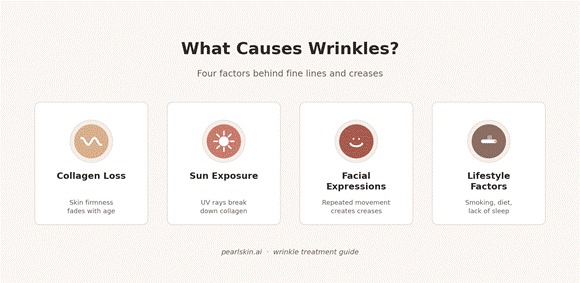
Wrinkles form because of a combination of internal changes and external damage to the skin.
Collagen and Elastin Loss
Collagen and elastin are proteins that keep skin firm and elastic. Natural collagen production slows with age, and the skin gradually loses volume and firmness. This loss of structural support is one of the main reasons skin develops fine lines and sagging over time.
Sun Exposure and UV Damage
Sun exposure is considered the most powerful driver of visible skin aging. UV rays break down collagen and elastin fibers, causing rough texture, uneven tone, and deeper wrinkles years before they would otherwise appear. This is why sun protection is central to most anti-aging strategies.
Repeated Facial Expressions
Frowning, squinting, and smiling repeatedly create dynamic wrinkles, including forehead lines, crow's feet, and expression lines around the mouth. Over time, repeated muscle movement can turn these temporary lines into permanent creases, called static wrinkles.
Lifestyle Factors
Smoking, poor diet, dehydration, and inconsistent sleep all accelerate skin aging. Smoking in particular restricts blood flow and breaks down collagen, while a diet low in antioxidants leaves skin more vulnerable to damage. Poor sleep and dehydration also leave facial skin looking tired and less resilient, so prioritizing rest and hydration supports both skin health and a smoother appearance over time.
Types of Wrinkles
Not all wrinkles are the same, and the type affects which treatment works best.
● Fine lines — shallow, early-stage lines, often the first visible signs of aging
● Dynamic wrinkles — appear only during facial movement, such as crow's feet or frown lines
● Static wrinkles — remain visible even when the face is relaxed, caused by long-term collagen loss
● Deep wrinkles and folds — includes nasolabial folds, which run from the nose to the mouth, and often need professional treatment for real improvement
Topical Ingredients That Help Reduce Wrinkles
Certain ingredients have strong evidence behind them for improving skin texture and reducing the appearance of fine lines and wrinkles over time. Choosing a few science-backed products consistently does more for skin health and texture than switching formulas every few weeks.
|
Ingredient |
How It Works |
Best For |
|
Retinoids (retinol) |
A vitamin A derivative that speeds up cell turnover and boosts collagen production |
Fine lines, uneven texture, general anti-aging |
|
Vitamin C (ascorbic acid) |
An antioxidant that protects against sun damage and brightens overall complexion |
Dullness, early signs of aging, uneven tone |
|
Hyaluronic acid |
Draws moisture into the skin, plumping fine lines and improving hydration |
Dryness, dehydrated skin, fine lines |
|
Peptides |
Signal the skin to produce more collagen, gradually improving firmness |
Loss of firmness, deeper lines |
|
Niacinamide |
Calms irritation and supports the skin barrier while improving texture |
Sensitive skin, redness, rough texture |
Bakuchiol, a plant based retinol alternative, offers similar benefits with less risk of skin irritation for sensitive skin, and hyaluronic acid remains one of the most reliable ways to boost skin hydration.
New actives should be introduced gradually, since retinoids and some acids can cause temporary irritation. Combined with a broad-spectrum sunscreen every morning, these ingredients form the foundation of an effective skin care routine. A vitamin C serum in the morning and a retinoid serum at night are two of the most well-studied products for supporting long-term skin health, and a well-formulated serum layered under moisturizer often outperforms a heavier cream alone. Adding one new active at a time to your skin care routine, rather than several at once, helps reduce the appearance of irritation while allowing results to show more quickly.
For aesthetic clinics in Dubai, clear treatment education and a strong local online presence help patients make informed decisions before booking. Odyssey Marketing LLC supports UAE healthcare and beauty businesses with Local SEO, content strategy, and lead-generation solutions.
At-Home and Natural Remedies for Wrinkles
Alongside proven topical ingredients, several natural remedies are popular for supporting skin health and softening fine lines:
● Aloe vera may smooth wrinkles and support collagen production when applied consistently or taken as a daily supplement.
● Olive oil contains fatty acids and antioxidants that support skin elasticity when massaged into the skin.
● Facial massage and gentle facial exercises can temporarily boost circulation and cheek fullness, though results are mild compared to topical treatments and professional products.
● A diet rich in antioxidants, such as fruits, salmon, and walnuts, supports skin health from within and may reduce the visible signs of aging.
These remedies work more slowly than clinical ingredients and are best used alongside, not instead of, a consistent skin care routine and daily sunscreen, both of which do more for lasting skin health than any single home remedy.
Professional Wrinkle Treatments
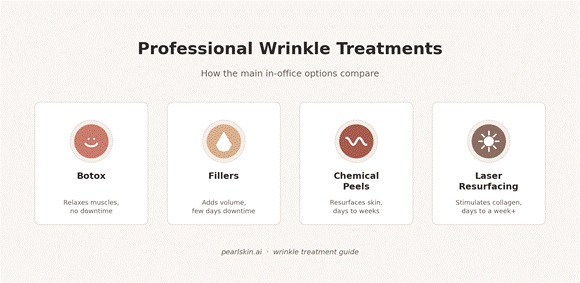
For deeper wrinkles or faster, more dramatic results, professional treatments performed by a board-certified dermatologist tend to outperform over-the-counter products, though they work best as part of an ongoing skin health routine rather than a one-time fix.
|
Treatment |
How It Works |
Downtime |
Results Last |
|
Botulinum toxin (Botox) |
Relaxes the muscles that cause expression lines, such as forehead lines and crow's feet |
None to minimal |
3 to 6 months |
|
Dermal fillers |
Add volume to areas affected by fat and collagen loss, such as nasolabial folds |
A few days |
6 months to over a year |
|
Chemical peels |
Use acids such as glycolic acid, salicylic acid, or trichloroacetic acid to remove damaged outer skin layers and smooth texture |
Days to two weeks |
Weeks to months |
|
Microneedling |
Creates tiny injuries that trigger collagen production and skin renewal |
One to two days |
Cumulative, over weeks |
|
Laser resurfacing |
Removes or heats skin layers to stimulate collagen and refine texture |
Days to a week or more |
Months to years |
Recovery times can vary from zero downtime for Botox to a few days of redness after microneedling or a couple of weeks for more intensive laser resurfacing. Many patients combine treatments, such as Botox for forehead lines with a filler for smile lines, to address different facial concerns at once.
Daily Skincare Routine to Prevent and Treat Wrinkles
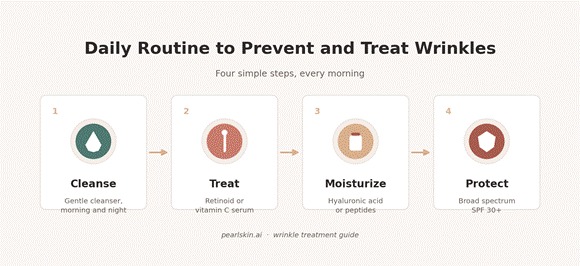
A consistent daily routine supports any treatment and helps prevent new wrinkles from forming:
1. Cleanse gently, morning and night, to remove impurities without stripping the skin barrier.
2. Treat with a retinoid or vitamin C serum to smooth texture and support collagen production.
3. Moisturize with hyaluronic acid or peptides to maintain hydration and skin firmness.
4. Protect with a broad-spectrum sunscreen, SPF 30 or higher, applied every single day.
Sun protection is widely considered the single most effective way to prevent new wrinkles and protect the results of any treatment, topical or professional. Sunscreen alone can prevent wrinkles from forming years before other options are even needed, and many over the counter serums now include broad spectrum SPF alongside antioxidants. Following these four steps daily supports long-term skin health, not just the appearance of fewer lines.
So, What Is the Best Wrinkle Treatment?
For most people, the best wrinkle treatment is not one single product or procedure, but a combination that matches the type of wrinkles being treated. Daily sunscreen and a retinoid remain the most cost-effective way to prevent new fine lines and soften existing ones. Dynamic wrinkles, like crow's feet and frown lines, generally respond best to botulinum toxin injections, while volume loss and deep folds respond better to dermal fillers or laser resurfacing.
Combining approaches, such as a daily skincare routine with occasional professional treatments, generally delivers more noticeable and longer-lasting improvement than relying on any single option alone. Whatever combination is chosen, protecting skin health with sunscreen and a handful of proven products remains the foundation everything else builds on.
How to Choose the Right Treatment
A few questions help narrow down the right approach:
● Are the wrinkles dynamic, static, or a mix of both?
● Is the main goal prevention, subtle improvement, or a more dramatic change?
● How much downtime and expense feel realistic?
● Is the skin sensitive, requiring gentler formulas and milder in-office options?
A dermatologist reviewing facial anatomy and skin type can match products to the right treatment plan. Retinoids are often combined with other ingredients like peptides and niacinamide, and there are many treatments that work well together as part of a broader anti aging plan overseen by a board certified dermatologist. A consultation with a board-certified dermatologist helps match answers to these questions with a targeted, realistic treatment plan.
Dermatologist's Note: Dermatologists frequently note that consistency and sun protection matter more than chasing the newest product. A simple, well-chosen skin care routine combined with proven ingredients like retinoids often delivers better long-term results than expensive treatments used inconsistently. Professional procedures can accelerate improvement, but they work best alongside daily prevention, not as a replacement for it, and protecting skin health for years to come.
Frequently Asked Questions About Wrinkle Treatments
What is the most effective wrinkle treatment overall?
Daily broad-spectrum sunscreen is considered the single most effective way to prevent new wrinkles, while retinoids have the strongest evidence among topical products for improving existing lines.
How long does it take to see results from wrinkle treatments?
Topical ingredients like retinoids and vitamin C typically take several weeks of consistent use to show visible improvement, while Botox delivers results within three to five days.
Are natural remedies effective for wrinkles?
Natural remedies such as aloe vera and a diet rich in antioxidants may offer mild, gradual improvement, but they work more slowly than clinical ingredients or professional treatments.
Is Botox or filler better for wrinkles?
Botox works best for dynamic wrinkles caused by muscle movement, such as forehead lines, while fillers are better suited to static volume loss, such as nasolabial folds.
Do wrinkle creams really work?
Over-the-counter wrinkle products such as creams and serums can improve texture and provide modest improvement, especially with ingredients like retinol, vitamin C, and hyaluronic acid, though results are typically less dramatic than professional treatments.
Do wrinkle treatments improve overall skin health?
Yes — many treatments and products, from retinoids to laser resurfacing, support collagen production, skin texture, and overall skin health, not just the visible appearance of lines.
For deeper concerns that a home routine alone cannot fully address, booking a professional anti wrinkle treatment lets a board-certified dermatologist target stubborn lines directly and tailor a plan to the skin's specific needs.