


Table of Contents
-
Introduction
-
The part most people get wrong
-
What each piece of the appliance does
-
How a tooth travels through bone
-
Why treatment is measured in months
-
What happens at an adjustment visit
-
The three phases of treatment
-
Types of braces you may be offered
-
Why retainers are part of the plan
-
Conclusion
-
Contact us
Introduction
Patients usually agree to have braces fitted even though they are never explained how the braces work. Once the braces are put on, the visits start, and the teeth then gradually move into different positions in a way that is a bit like magic and a bit like waiting.
When you understand how it works, the entire experience becomes much simpler: the days when you're in pain begin to make sense, the slow months no longer seem like a waste of time, and explanations regarding elastics and retainers become something you actually follow because you know the reason for their existence rather than just because someone has instructed you to.
The article sets out to explain dental braces using ordinary language, detailing the functions of the various parts, describing how a tooth moves through solid bone, and outlining what takes place at each stage of orthodontic treatment.
The part most people get wrong
If you ask ten people how dental braces function, most will say that the brackets clamp around the teeth and pull them into alignment, similar to tightening a shoelace. That is a plausible answer. It is also incorrect.
Teeth are not like nails being hammered into wood since each root is set in a socket and is cushioned by a thin layer of fibres with living bone that is always renewing itself around it. Braces don't pull teeth through the bone; instead, they exert a light and continuous pressure in one direction, and your body then rebuilds the bone around the root so that the tooth ends up in a new position.
That one idea accounts for almost all the other aspects of treatment, such as why it cannot be rushed.
What each piece of the appliance does
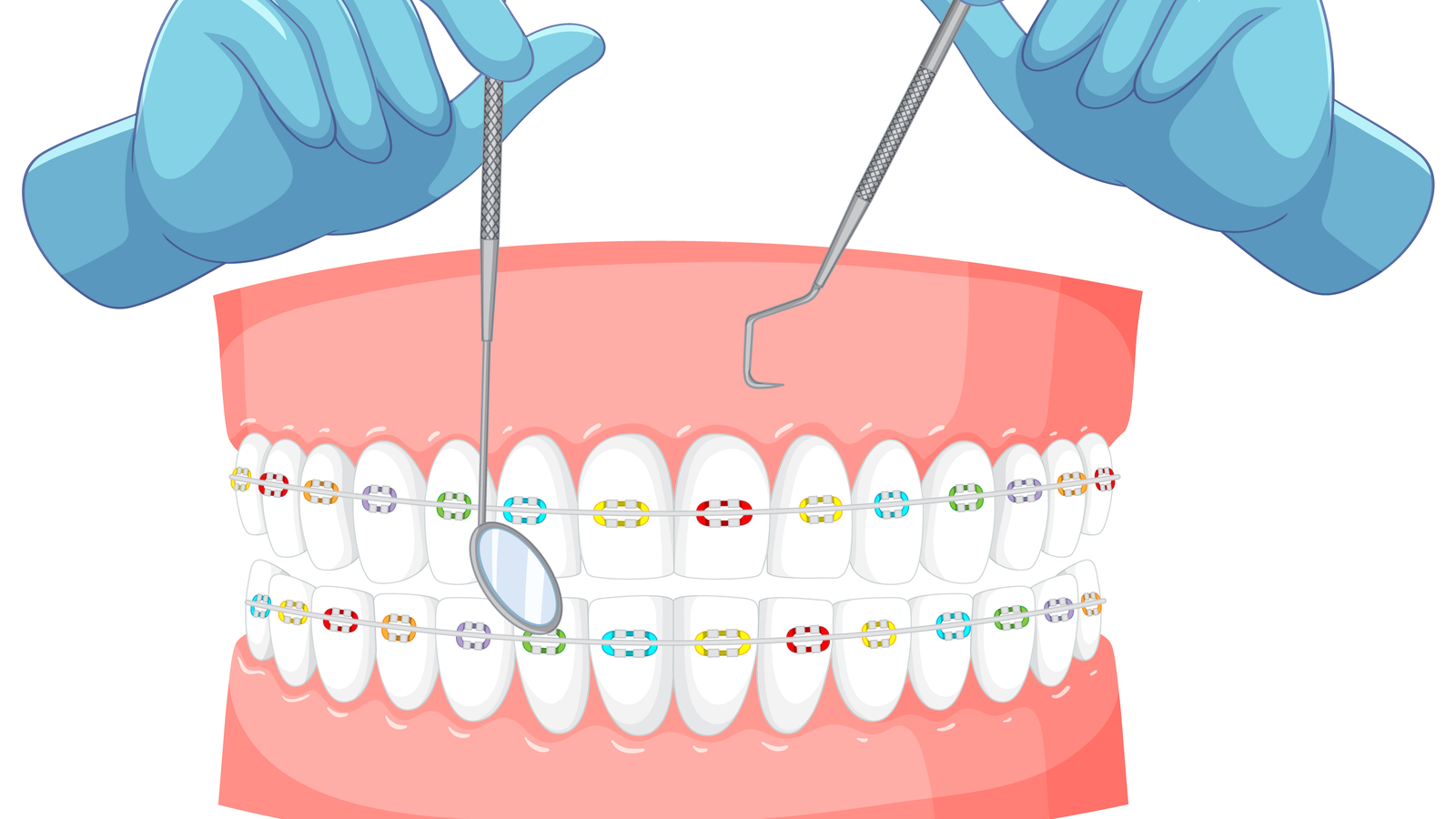
The bracket is a small square which is attached to the front of each tooth; by itself it serves no purpose other than offering a fixed point for something else to push against.
It is the archwire that carries out the actual work; this thin wire passes through all the brackets and has a tendency to resume its natural curve. Because your teeth are keeping it from assuming that shape, it exerts a gentle push as it attempts to straighten them, and your teeth then move gradually along with it.
Ligatures are small elastic rings or metal clips which hold the wire in place within each bracket; coloured ones are favourite with younger patients and self-ligating brackets have a small door built into them in place of the rings.
Bands are metal rings which, in some cases, are cemented around the back molars when these teeth have to bear more force.
Elastics are the rubber bands that are stretched between the upper and lower brackets; their function is different from that of the wire since, rather than straightening individual teeth, they adjust the way the two jaws come together. Since patients have to wear them at home, this is the only section of the appliance whose effectiveness relies on the patient rather than on the equipment.
How a tooth travels through bone
Imagine that pressure is applied to one side of the root. On that side, specialised cells remove a small quantity of bone in order to allow space. At the same time, on the side from which the root has moved away, other cells deposit new bone to fill the gap. Since both of these processes occur simultaneously, the tooth remains firmly supported during treatment even though it is moving.
What people find surprising is that a gentle force is more effective than a strong one; if you push too hard, you end up squeezing the blood supply in that thin layer of tissue and thus slow the entire process down. The wires currently in use are made from alloys and exert a mild force over a long period, and some of them become gradually more active as they warm up to body temperature in the mouth.
Why treatment is measured in months
When you opt for orthodontic treatment, Bone remodelling proceeds at its own rate, and no appliance can accelerate biology; teeth usually move by a fraction of a millimetre each month, a speed that seems slow when you calculate it over a period of a year.
Various movements require different amounts of time. Tipping a tooth is a fairly fast procedure, but moving an entire root through the jaw, rotating a difficult premolar, or closing the gap left after a tooth has been extracted takes much longer. This is the reason why your dentist provides a range of dates rather than an exact one. The estimate is based on the specific movements needed in your individual case and on how your body responds during the process.
What happens at an adjustment visit
Appointments that occur every four to eight weeks are generally of short duration and uneventful; the dentist examines how far the teeth have moved, takes out the existing wire, and then either puts in a new one or makes adjustments to the one currently in place.
The early wires are thin and flexible since the aim is gentle alignment, while the later wires are thicker and more rigid because the finishing work requires precision rather than flexibility. When you visit, any broken brackets are replaced, the elastics are checked, and any area that has been causing friction is looked at. It is normal to experience a slight soreness for a day or two afterwards, and this disappears as the teeth get used to the situation.
The three phases of treatment
Alignment is the first step; crooked and rotated teeth are corrected so that they form an even arch, and it is at this stage that the most noticeable changes take place, which in turn keeps the patients motivated.
Correction comes next, and now the focus is on the way the upper and lower teeth come together, with the gaps being closed and elastic bands frequently coming into play. Although the more substantial work is being carried out, progress in this area seems to be slower.
Adjustment - The final touch completes the treatment. Each tooth is carefully adjusted through these minor improvements, and when the dentist is satisfied with the way the teeth fit together, the brackets are then removed.
Types of braces you may be offered
Metal brackets are the most versatile choice and cope effectively with complicated situations. Ceramic brackets are tooth-coloured and are much less obvious when viewed at a normal conversational distance. With lingual braces, the brackets are placed behind the teeth so that they are not seen from the front, although they require a longer time for speech to adjust to them. Clear aligner treatment is suitable for some cases and can be taken out when eating, but the results depend on the number of hours the trays are worn. If you are comparing the different types of braces in Dubai, you will find that all of them are available, and the true answer as to which one is suitable for you can only be obtained from your medical records and not from a brochure. All the factors relating to your bite, the amount of crowding, and your age rule out most of the options before any question of personal preference arises.
Why retainers are part of the plan
After teeth have been moved, the bone still remains in a state of adjustment, and so the teeth tend to move back towards their original positions since there is no support. Retainers are used to keep the teeth in their new position while the bone matures.
A few patients are given a thin wire which is bonded onto the front teeth, while others are provided with a clear tray or plate that they wear according to a schedule. A number of patients have both the wire and the tray. It is important to regard retainers as the last stage of orthodontic treatment and not as an afterthought if you are to preserve the months of work carried out previously. Your dentist will establish a wearing schedule in accordance with your particular case and will then go over it during your follow-up appointments.
Conclusion
The concept of braces is simple yet carried out with great precision: there is a wire that needs to be straight, brackets which provide something for it to push against, and a bodily response that rebuilds bone. Once you know all that, the treatment becomes a process that you can follow, and patients who understand the reasons behind it tend to find it much easier to accept the waiting period.
Contact us
If you're looking for a dentist in JVC, our team is here to help.
Name: Magnum Dental Clinic – JVC
Address: Arcadia Tower, Shop 2, Beside CART Supermarket, Jumeirah Village Circle, Dubai, United Arab Emirates
Phone: +971 50 719 3374













Comments
0 commentsNo comments yet. Be the first to share your thoughts!