

SEE Holding Highlights 10 Years of The Sustainable City at AIM Congress 2026

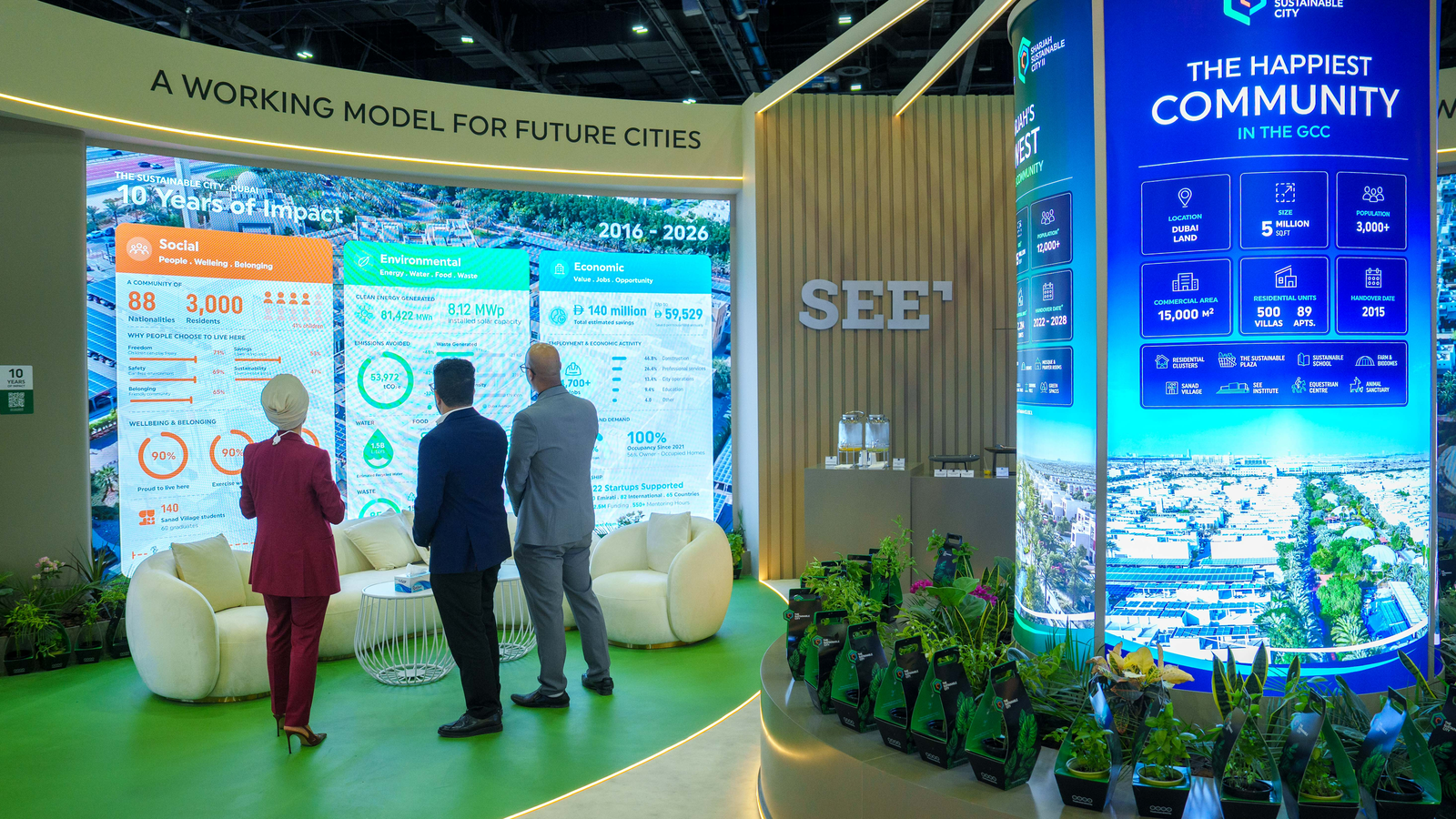
SEE Holding is marking a decade of The Sustainable City at AIM Congress 2026, highlighting operational results that it says demonstrate the environmental, social and economic value of sustainable urban development.
Since residents moved into The Sustainable City in Dubai in 2016, the community has developed into a fully operational model for sustainable living, generating measurable outcomes across energy, emissions, water, food production, waste, mobility, economic value and community wellbeing.
AED 140 Million in Savings Over a Decade
According to SEE Holding, The Sustainable City has generated an estimated AED 140 million in savings for residents over the past decade.
The savings have been attributed to lower utility costs, integrated solar generation, and efficiencies in services and maintenance.
The community's environmental performance has also recorded significant reductions compared with UAE and Dubai benchmarks.
SEE Holding reports that The Sustainable City has achieved:
- 78% lower carbon footprint compared with the UAE average
- 48% less waste per resident than the national average
- 42% lower water consumption compared with the Dubai average
The figures are being presented by the company as evidence that sustainable urban development can deliver measurable economic and environmental benefits alongside residential services.
Resident Wellbeing Forms Part of Sustainability Model
SEE Holding's assessment also extends beyond environmental indicators to resident wellbeing and quality of life.
Its latest resident survey found that 90% of residents feel proud to live in the community, while 90% exercise weekly and 89% spend at least 30 minutes outdoors each day.
The company says these findings demonstrate the potential relationship between sustainable urban design, access to outdoor spaces and healthier lifestyles.
AI to Shape the Next Generation of Cities
The operational experience of The Sustainable City is also informing SEE Holding's next-generation urban development model.
The company plans to incorporate artificial intelligence into homes, infrastructure, mobility and services, with the aim of improving efficiency, anticipating needs and creating more responsive and connected urban environments.
Rather than treating AI as a standalone technology, the next-generation model is intended to integrate it across multiple aspects of everyday urban life.
Greater Resource Independence in Future Communities
SEE Holding's future city model also places greater emphasis on resource independence.
Future communities are being designed to produce and manage a larger share of their essential energy, water and food requirements, while incorporating net-zero-ready infrastructure, circular resource systems, low-carbon mobility and nature-positive planning.
The approach also places greater emphasis on health, longevity, education, research and entrepreneurship, broadening the concept of sustainable cities beyond environmental performance.
SEE Holding Takes Sustainable Cities Vision to AIM Congress
SEE Holding's participation at AIM Congress 2026 comes as policymakers, investors, innovators and business leaders gather to discuss sustainable and inclusive economic growth.
The congress is being held under the theme, “Reshaping Global Prosperity: Unlocking New Investment Pathways Towards a Sustainable and Inclusive Future.”
For SEE Holding, the decade-long performance of The Sustainable City provides an operational foundation for discussing how sustainable urban models can attract long-term investment and be adapted to different markets.
From a Dubai Community to a Scalable Urban Model
The 10-year milestone represents a shift from demonstrating sustainability through a single development to using operational experience as a blueprint for future cities.
By linking measurable environmental and social outcomes with economic value, SEE Holding is positioning The Sustainable City as a real-world model for how sustainable urban development can be developed, financed and scaled.
The company says the next phase will build on the lessons of the past decade while using AI, resource independence and integrated infrastructure to create cities that are more efficient, connected and resilient.